
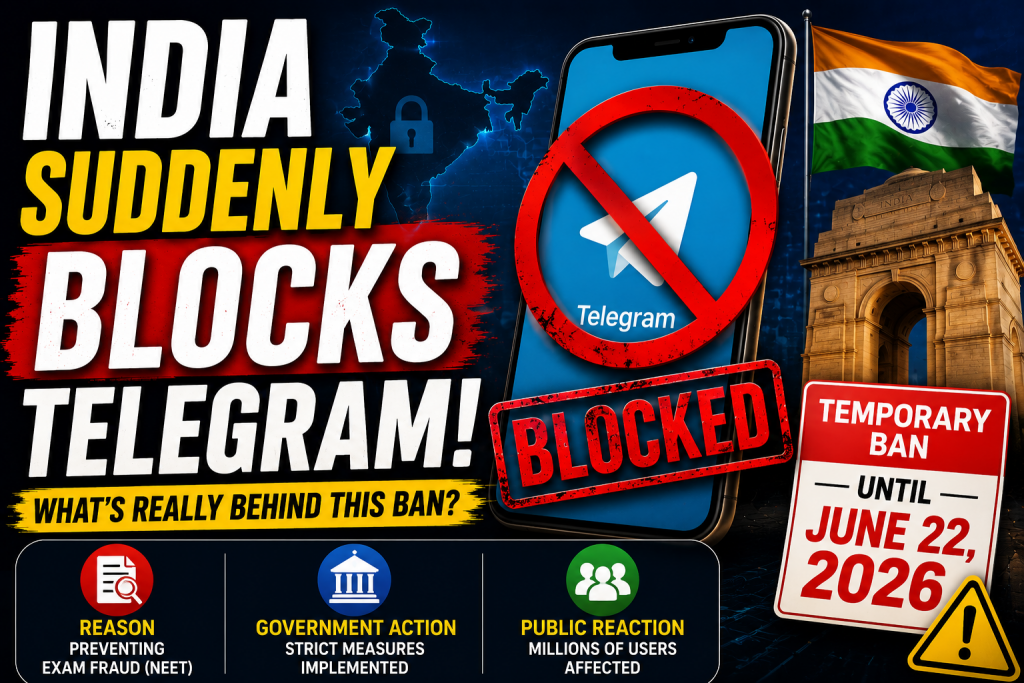
India has temporarily restricted access to the popular messaging platform Telegram until June 22, 2026, in an effort to prevent cheating and misinformation related to the country’s national medical entrance examination, known as NEET (National Eligibility cum Entrance Test). The move has sparked debate about the balance between exam security and digital freedom. (Reuters)
Why Did India Block Telegram?
According to India’s Ministry of Education and the National Testing Agency (NTA), Telegram was allegedly being used by organized groups to spread fake exam papers, coordinate cheating activities, and circulate misleading information ahead of the NEET 2026 re-examination scheduled for June 21. Authorities stated that previous efforts to remove fraudulent content from the platform were not effective, leading to the temporary restriction. (Reuters)
The government described the action as a “last resort” measure aimed at protecting the integrity of one of the country’s most important examinations. The restriction was imposed under provisions of India’s Information Technology Act, which allows authorities to block online platforms under specific circumstances. (Reuters)
Background: The NEET Exam Controversy
The controversy began after authorities discovered irregularities and alleged question-paper leaks in the original NEET 2026 examination. As a result, the government ordered a re-examination and launched investigations into several cheating networks. Officials claim that some of these networks were using Telegram channels and groups to target students with fraudulent schemes and leaked materials. (Reuters)
Given the scale of the exam, which is used for admission into medical colleges across India, authorities have taken strict measures to prevent further misconduct.
Additional Restrictions
Reports indicate that Indian authorities also requested limitations on Telegram’s message-editing feature, arguing that it could be exploited to alter and distribute misleading exam-related information. Some users reported reduced access to certain Telegram services following the government’s directive.
Public Reaction
The temporary restriction has generated mixed reactions. Supporters argue that protecting the fairness of a national examination is a legitimate reason for government intervention. Critics, however, warn that blocking a widely used communication platform may affect millions of users who rely on Telegram for education, business, and personal communication. They also raise concerns about freedom of expression and digital rights.
What Happens Next?
The restriction is currently scheduled to remain in effect until June 22, shortly after the NEET re-examination takes place. Indian authorities have stated that the measure is temporary and focused solely on preventing exam-related fraud. The government’s next steps will likely depend on the outcome of the re-examination and ongoing investigations into cheating networks.
Conclusion
India’s decision to temporarily block Telegram highlights the growing challenge governments face in balancing technology, security, and public access to digital communication platforms. While authorities view the restriction as necessary to protect the integrity of a major national examination, the move also raises broader questions about the role of messaging platforms in combating misinformation and online fraud.
SEO Meta Description:
India has temporarily blocked Telegram until June 22, 2026, to prevent cheating and misinformation ahead of the NEET medical entrance exam re-test. Learn why the restriction was imposed and its potential impact.
